I’m Just Saying: It’s Time to Take Back Public Education

Somehow, the people who lead our governmental, philanthropic, and corporate sectors have decided that urban public education should be shaped and guided by corporate executives. Let me say this plainly: that decision is one of the greatest educational atrocities of our time. It may very well be the reason our children continue to be failed by the very systems meant to uplift them.

What troubles me even more is that we, as a society, don’t seem to recognize how deeply capitalism—unchecked, unchallenged, and unexamined—has damaged the world we live in. And before anyone starts labeling me a communist or socialist, let me be clear: I am a follower of Christ. Through a Christian lens, I view this conversation about education, human dignity, and communal responsibility.

Recently, I attended the screening of a new documentary produced by Mr. Quan Neloms. In it, a community activist said something that struck me with the force of a thunderbolt:
“Our students are not failing; our system is failing our students.”
That statement alone is worth a hundred billion dollars—especially since we’ve begun evaluating everything through the lens of dollars and cents.

For more than twenty years, I have watched our public educational institutions shift from being grounded in urban pedagogical wisdom to being transformed into corporate training centers. The focus is no longer on children, families, or community. Instead, the agenda is shaped by corporate profitability and workforce preparation. We have displaced parents from the center of their children’s educational journey and handed that authority to corporate and philanthropic executives—many of whom have never taught, never lived in our communities, and never raised a Black or Brown child.

And the justification seems to be rooted in a dangerous, unspoken theory:
that urban parents lack the love, care, or competence to know what is best for their own children.

What’s even more alarming is that far too many faith-based institutions have bought into the same narrative. Churches—historically the backbone of Black educational empowerment—are now echoing corporate talking points rather than community wisdom. Our system has shifted from prioritizing the public good to prioritizing profit. From nurturing critical thinkers to mass-producing compliant workers.

I often wonder what Horace Mann, the father of American public education, would think about the direction in which we’ve drifted. He fought for an education system that served everyone, but he was not confronted with the realities of race and diversity as we are today. Would he be shocked? Or would he say that the inequities we see are intentional design?

And that’s the question I wrestle with:
Are those in high places truly committed to giving Black and Brown children a quality education—one that would make them competitive with the privileged?

Back in 1973, my dear friend Judge Longworth Quinn Jr., who served on the Detroit Public Schools Board, said something I’ll never forget:
“The only hope for educational reform would be to blow it up and redesign it.”
More than 50 years later, he might very well have been an educational prophet.

We cannot allow our system to be reimagined by people whose primary interests are reform metrics, funding streams, and political agendas—not the dignity and destiny of our children. As my friend and retired educator William Batchelor often reminds me,
“We know how to educate our children.”
And my response today is: Let’s move the systems out of the way and let the educators do what they were called to do.

Beginning this February, Be-Moor Radio and the Be-Moor Radio Institute will launch an educational podcast series titled “Class Is in Session. This platform will feature students, educators, retired educators, parents, community leaders—and yes, we want you to be part of it. Our goal is to build a real, authentic grassroots movement that transforms education with tangible, measurable results.

We hope to uplift the legacy of champions like Helen Moore, Judge Longworth Quinn Jr., Fannie Jackson Coppin, Benjamin Banneker, Mary McLeod Bethune, and my aunt Katie E.M. Mallett—a proud Jackson State graduate who, as a young girl in Kosciusko, Mississippi, taught all her siblings before moving to Detroit and serving the Highland Park School System. These are the giants whose shoulders we stand on. And they are joined by thousands of unnamed educators who have carried the torch of Black educational excellence quietly and faithfully.

It is time—past time—to reclaim public education for our Black and Brown children. Time to rewrite our academic agenda based on our history, our values, our culture, and our vision.

So I ask you—
What say you?

Scam Alert – A Note to Senior Citizens

I want to warn all my fellow seniors to stay alert — a very convincing T-Mobile scam is making the rounds, and I fell victim to it this weekend. Here’s how it works:

Scammers call claiming to be from the T-Mobile Loyalty Department. They sound professional and offer tempting deals, such as a new phone or smartwatch, along with a credit on your bill. They’ll even say you just need to pay the taxes on the new device.

What makes it frightening is that they appear legitimate — they have access to your T-Life account information, which makes it seem like they’re truly from T-Mobile. But it’s a scam! Once they get your payment, you’ll never see the phone, the credit, or your money again.

Even worse, when I reached out to T-Mobile customer service, I received no real help or compassion. Their response was essentially, “There’s nothing we can do.”

My story started when I called T-Mobile about a mysterious line on my bill — one I never opened or used. Days later, I got a call from “the loyalty department” offering to fix it. That call was from scammers. This may even involve overseas access to customer information or apps like T-Life.I’ve been using computers since the early days of the early Radio Shack TRS 80 in the early 80’s, and I still got caught. If it can happen to me, it can happen to anyone. There are so many varibles in the world of scammers. Here a few suggestions:

First, please, my friends, be careful. Never share personal or payment information over the phone. Hang up and call T-Mobile directly using the number on your bill or their official website, although they may, as in my case, offer little assistance. Monitor your accounts and report any suspicious activity immediately. Use a credit card versus a bank card!

We are all vulnerable in this new world of high-tech scams. Don’t let them fool you — stay alert, stay skeptical, and protect yourself!
I’m Dennis Talbert, and I’m Just Saying….

Calling All Cass Technical High School Alumni: A Century of Excellence Worth Celebrating

This month marks a remarkable milestone — the 100th Anniversary of the Cass Technical High School Harp and Vocal Program. In a time when we so often hear what’s wrong with public schools, especially within the Detroit Public Schools Community District (DPSCD), it’s important to pause and celebrate what’s right. Hidden within DPSCD is a shining jewel — the Cass Tech Harp and Vocal Program — led by the incomparable Ms. Lydia Cleaver.

Ms. Cleaver, a devoted educator and faithful member of my church, embodies what it means to serve with excellence and love. Day after day, she stands in the classroom as a steady force, doing the sacred work of teaching amid the chaos and challenges our community brings to her through its children. No matter their circumstances, Ms. Cleaver finds ways to lift, inspire, and prepare her students to rise beyond what many could ever imagine.

Think about it: teaching the harp — one of the world’s most delicate and expensive instruments — to Detroit’s young people, many of whom rely on public transportation just to get to school and benefit from free and reduced lunch programs. Yet when you encounter Ms. Cleaver’s students, you feel as if you’re standing in the presence of royalty. Their poise, grace, and confidence radiate urban sophistication and class.

Ms. Cleaver doesn’t seek recognition. She’s too busy molding the next generation of classical musicians. But her impact deserves to be acknowledged. Over the years, she has taken her students to Carnegie Hall in New York, to Europe, and to national and international competitions — all on what she calls a “McDonald’s hamburger budget.” Through sheer faith, creativity, and sacrifice, she has found ways to make the impossible possible.

It’s time we — the Cass Tech alumni community — rise to honor her and this program that has produced legends such as Dorothy Ashby and Alice Coltrane, and nurtured the same caliber of artistry that once surrounded Diana Ross. Ms. Cleaver herself is a proud Cass alumna and a graduate of the University of Michigan School of Music. She continues to campaign tirelessly to place harps in the hands of her students so they can practice and perfect their craft beyond school hours.

A hundred years of excellence is no small feat. It’s a living testimony that greatness still flows from the Detroit Public Schools Community District. Ms. Cleaver represents hundreds of dedicated teachers — past, present, and retired — who pour out their hearts and lives so our children can succeed, even in the most challenging circumstances.

To all Cass Tech alumni, and to all who love Detroit — this is our moment to say thank you. Let’s show our gratitude by showing up, giving back, and celebrating what is still beautiful and powerful about our schools.

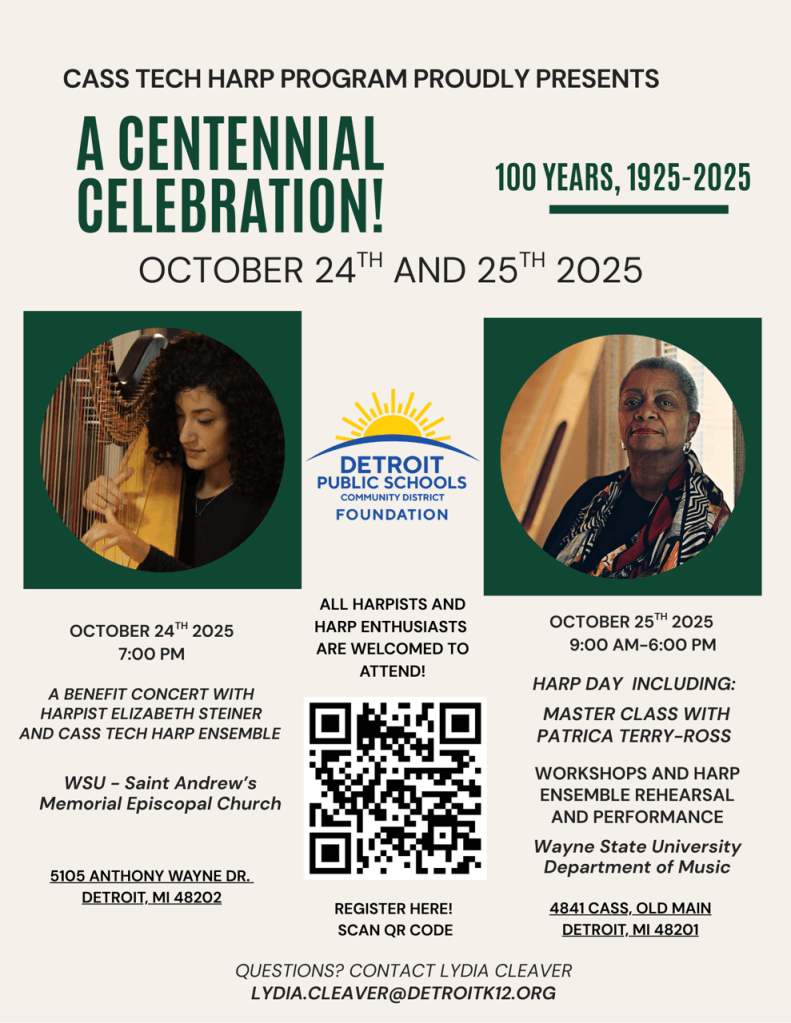
🎶 Cass Tech Harp Program: A Centennial Celebration
100 Years: 1925 – 2025
📅 Thursday, October 24th, 7:00 PM
📍 Wayne State University’s Saint Andrew’s Memorial Episcopal Church
5105 Anthony Wayne Drive, Detroit, MI 48202

🎵 Master Class with Patricia Terry-Ross
📅 Friday, October 25th
📍 Old Main, Wayne State University
4841 Cass Avenue, Detroit, MI

Thank you, Ms. Lydia Cleaver, and thank you to every teacher who has ever sacrificed, inspired, and believed in our children. We may not say it enough, but today, from the bottom of our hearts — we are grateful.

A Call to Wake Up: Giving Our Children a Fighting Chance

On Thursday, October 9, 2025, a seventeen-year-old young man was shot in the back—just twenty feet in front of my home—by a white adult male. I mention his race not out of racial animosity, but because it’s uncommon to see a white man on my street, and this man needs to be found and taken off the streets of Detroit.

Yesterday, I learned that the young brother died from his wounds.

As I sat in my home office that day, I heard a single gunshot. When I opened my blinds, I saw the young man lying motionless in the street and the White man running to his white Ford 150. I rushed outside, joined by a young man working in my home. As we knelt beside him, he kept repeating, “I don’t want to die.” We tried to reassure him that he would live while calling 911.

Within minutes—no more than three or four—Detroit’s first responders arrived and worked with professionalism and urgency. The police investigators spent over an hour inside my home and at least three hours outside gathering evidence and statements. But the young man never had a fighting chance. He was shot in the back.

That night, I lay awake hearing his words—“I don’t want to die”—echoing in my mind. Those words still ring in my ears. And the painful truth is this: just as that young man didn’t have a fighting chance, so it is for far too many children and youth growing up in our communities across urban America.

The next morning, I had to return to the rhythm of my daily ministry—praying with high schoolers at 6:30 a.m., as I’ve done for over 25 years, and later launching a new small group of young leaders through Be-Moor Radio.

That same day, only a few blocks from my house, tragedy struck again. At our neighborhood elementary school, a young girl stabbed another student—using a knife her mother brought to the school and handed to her. Yes, the mother gave her daughter a weapon and told her to use it.

Our children are in trauma. Our communities are in trauma. And too many have no fighting chance.

We no longer have a North Star—no shared moral compass or value-centered community. Black church, wake up! This is our role, our commission, and our divine assignment. Luke 4:18-19 makes it clear: “The Spirit of the Lord is upon me, because He has anointed me to preach good news to the poor…”

We need a reset—a return to our mission, our values, and our call to a people-centered spiritual renewal. Genesis 4:10 reminds us, “The blood of your brother cries out to me from the ground.” The blood of our sons and daughters is crying out from our streets for justice. They must not be forgotten.

Every child living in an urban community is experiencing trauma. In truth, every person in our communities is carrying trauma. We all need healing, hope, and an intervention—and the Black church, as the ambassador of Christ, is God’s chosen instrument for that healing.

Jesus said in John 10:10, “The thief comes only to steal, kill, and destroy; but I have come that you might have life—and have it more abundantly.”
An abundant life is a trauma-free life.

After decades of serving as an urban youth development specialist, I’ve seen more death and destruction than I care to recall. Yet this moment feels different. The urgency is greater. It was at my front door! The cries are louder.

Black church, wake up! It’s time for a people-centered revival—a movement that heals, restores, and reclaims our communities. Everything else we’re doing is insignificant compared to this call. As God said in Amos 5:21–23, “I hate your festivals (could it be our church services)… take away from me the noise of your songs (could it be our praise and worship).”

Let’s resolve, together, to give our children—and our communities—a fighting chance.

P.S. There is a Truth and Trauma Conference—sponsored by the Detroit Leadership Foundation—that will be held on Saturday, November 18th, from 9:00 a.m. to 3:00 p.m. at the McGregor Memorial Conference Center on the campus of Wayne State University.
Get healed. Get equipped. And let’s get to work.


Innovation: A Holy Calling for the Black Church

Innovation can sound like a curse word in some Black church circles. But for me, it’s never been about chasing trends or stirring up controversy. It’s always been about one thing—staying faithful to Christ’s call in ways that truly speak to the times.

I’ve always been drawn to swimming upstream. Not because I love conflict, but because I love discovery. I love finding new ways to reach Black children, youth, and families with the timeless message of Jesus.

Just this week, I found myself on the phone with a young man, talking about a church experimenting with fresh approaches to worship and community. At first, we both slipped back into the comfort of “how we used to do things.” But when I hung up, the Spirit convicted me: Talbert, are you losing your edge?

I’ve always believed that innovation should beat at the heart of every urban church that’s serious about advancing the Kingdom of God. The world may call it innovation, but I call it being in the right place, at the right time, with the right message—Christ.

Paul captured this spirit in 1 Corinthians 9:19-23 when he said:

“Though I am free and belong to no one, I have made myself a slave to everyone, to win as many as possible… I have become all things to all people so that by all possible means I might save some.”

That’s the essence of innovation: freedom to meet people where they are without ever compromising the gospel.

Of course, innovation comes at a cost. Financial risk. Skepticism from leaders. Resistance from traditionalists. I’ve paid that price, but I’ve also seen the fruit—and I’ll keep paying it, because innovation is the only way the church will stay effective in reaching our children, our neighbors, and the nations.

Hip Hop Sunday

Years ago, I grew weary of “Youth Sundays” that had become more about performance than proclamation. In my heart, it felt like heaven’s heartbreak hour. So, with my pastor’s blessing, we tried something different—Hip Hop Sunday. We filled the sanctuary with beats, rhymes, and the gospel, led by the old-school group Transformation Crusade.

From the very first track, something powerful happened: the seniors in the congregation lifted their hands in worship. God reminded us—it’s not about the style, it’s about the message. What started as one Sunday grew into a month. Young people packed the sanctuary, bringing their friends in droves. Attendance exploded to the point where men had to line the walls just to make room. One parent was so moved he bought every single youth a CD from the artist The Truth—not for himself, but to flood the community with gospel Hip-Hop music.

Eventually, Hip Hop Sundays ended—not because the Spirit wasn’t moving, but because the offering dipped and the men grew tired of standing. But for a season, God showed us what could happen when we broke free of tradition and let Christ lead us into new territory.

Sending Black Students to Africa

Later, while leading a major urban conference, I invited Rev. Bekele Shanko, a powerful African leader, to speak. His presence sparked resistance. Some didn’t think he belonged on that stage. But we pressed forward.

That night, Rev. Shanko called hundreds of Black college students to missions in Africa. The Spirit fell. Students pledged or gave more than $68,000 for ministry in Southeast Africa. The following summer, hundreds of young people—Black students—spent their summer serving people who looked like them, across the ocean.

Twenty years later, many of them are still on the field. Still serving. Still carrying the gospel. That’s the fruit of daring to innovate.

Why It Matters

Innovation is rarely comfortable. It can isolate you, even make you an outsider—especially in traditional Black church settings. But let’s be clear: innovation is not a threat to theology or doctrine. It’s an invitation to growth. When it’s rooted in Scripture and led by the Spirit, innovation strengthens the church.

Jesus Himself was an innovator. He broke religious traditions, shattered social barriers, and rewrote the script of history. His ministry birthed the New Testament church—the greatest innovation of all time.

I’m Just Saying….

A Tribute to the Chairman

Yesterday, I learned of the well-earned retirement of Mr. Mayce Webber as Chairman of the Deacon Board at Rosedale Park Baptist Church. And immediately, a flood of gratitude came rushing in.

If you know me, you know how much I love salmon. Like that determined fish, you have supported my swimming against the current —pressing upstream to create a first-class, Christ-centered, Black church-based youth ministry right in one of Detroit’s toughest neighborhoods. Looking back, I realize the vision I carried wasn’t always crystal-clear to you, or to most of the congregation and leadership. But you were steady, wise, and faithful—choosing to encourage and support me anyway, even when the path was hard to see.

Mr. Webber, you carved out space for our young people to dream big and thrive. Because of your unwavering “yes,” the Student Ministries Department (SMD) set a standard of excellence that rippled far beyond Detroit’s Black church community. I still remember the day we invited you into our little office down the street. Donnell Harlin and the team, along with me, shared our wild vision for youth outreach. Your face held the mystery of uncertainty, yet the words that leapt from your mouth—“You have my full support!”—ignited something powerful in us. Those words fueled our courage.

And we went to work. With your blessing, we did what once seemed impossible:

  • Built a Habitat for Humanity home from the ground up—the first youth group in the organization’s global history to lead such a project—partnering with Comerica Bank.
  • Adopted three neighborhood schools, forging genuine relationships with Vetal Elementary & Middle, Redford High, and Mann Elementary School.
  • Helped families move from homelessness to homeownership, with several of those households now boasting college graduates in every room.
  • Created a school-based program designed for underachieving elementary students that ultimately moved several students to Vetal’s 4.0 Club. Rosedale High School and college students developed the program and curriculum for  Super Kids. It created a hands-on and active learning environment as an after-school program.
  • Built three homes in Matamoros, Mexico; remodeled an orphanage in Jamaica; and hosted vibrant Vacation Bible Schools in the Bahamas, Jamaica, and in Detroit.
  • Launched countless Five-Day Backyard Bible Studies with a curriculum our own youth designed.
  • Advocated for Operation Sunrise, ultimately helping send more than 300 Black college students—including Rosedale youth—to serve in Southeast Africa, and Rosedale’s students in  Ethiopia.
  • Leading thousands to Christ either directly or indirectly through our partnerships, affiliations, or SMD.

These achievements matter—but what mattered most was knowing, deep down, that you had our backs. When our spirits sagged and our human batteries ran low, your words of encouragement lifted us.

On a personal note, your ministry of presence still humbles me. You sat with my brother through every one of my surgeries and hospital stays. I will never forget waking from recovery and hearing the very first voice—it was yours.

And, Mr. Chairman, you never missed an opportunity to exalt the name of Jesus. Whether holding the mic on Sunday or speaking quietly to one soul, you kept Christ at the center, always.

Your children—Chris, Jeffrey, Jason, David, and Rachel—are stars in their own right. But to me, you are a SUPERHERO.

Thank you, Mr. Webber, for showing us what steadfast faith, quiet strength, and joyful service look like. May God bless this new chapter as richly as you have blessed all of ours.

Are Black Children Resilient – Or Just Surviving?

The older I become, the more it feels as if the axles of this earth are moving faster and faster. The summer of 2025 has been a revealing one for me. I had the honor of serving 43 young people as interns—most from Detroit, a few from other parts of the country. What I witnessed in their lives has both inspired me and deeply troubled me.

What stands out most is how much adult trauma rests on the shoulders of our young people—trauma created by adults and absorbed by children. In just six weeks, I walked with young people through experiences that could shake anyone to the core.

  • One young man whose father was murdered by his grandmother.
  • A young lady, not yet twenty, is already raising three sons.
  • At least five who faced homelessness, forcing them to relocate—some across the city, others out of state.
  • A 21-year-old is already addicted to drugs.
  • Several more caring for an adult, whether a sick parent or a struggling grandparent.
  • A young man who was finishing his last treatment for cancer
  • A significant number of these young men and women are afflicted with ADHD

I spent my summer counseling, listening, and encouraging. And yet, I left with a sobering question: Are Black children truly resilient, or are they simply survivalists?

We know the story of Black people in this country. Oppression, racism, and systemic mistreatment have weighed heavily on our community. Out of that suffering, we have often celebrated “resilience.” But what if what we call resilience is sometimes just survivalist self-reliance—a posture that helps us endure, but also leaves us carrying wounds too heavy to heal on our own? Gina Samuels, writing about young people in the foster care system, calls this tension: “What doesn’t kill you makes you stronger.” But strength without restoration still leaves scars.

Resilience, in truth, is not just grit. It is the ability to manage stress and still function in the face of challenge. It is not a personality trait—it is a learned ability, something nurtured in families, churches, and communities. And because the adversity Black children face is often unlike that of others, our parenting, mentoring, and ministry must go deeper.

The Scriptures remind us of the truth of who our children are:

“Black children are fearfully and wonderfully made in the image of God (Psalm 139:14; Genesis 1:27). Though they may face trials, injustices, and obstacles, they are more than conquerors through Christ who loves them (Romans 8:37). The Lord is their refuge and strength, a very present help in trouble (Psalm 46:1). No weapon formed against them shall prosper (Isaiah 54:17), for God has plans to give them hope and a future (Jeremiah 29:11). Their resilience is not just survival—it is a testimony of God’s power, endurance, and faithfulness working through them (2 Corinthians 4:8–9).”

That’s why Christian urban youth development must move beyond pizza parties and Sunday School as usual. We are not just entertaining teenagers or babysitting children. We are confronting trauma, cultivating resilience, and building the faith that heals. This is the work of raising a generation that “knew not Joseph”—children growing up without memory of God’s wonders, unless we remind them.

This reality hit home again just last week. I stood among young adults in my neighborhood at the funeral of a young leader I had known since he was about 10 years old. He died of an overdose. His death haunts me—as should the death of every child who ever set foot in a Black church. Each life lost reminds us: our work cannot wait.

The question remains: Will we help our children do more than survive? Will we nurture a resilience rooted in faith, family, and community that allows them to thrive?

That is the calling on us all, and I’m just saying….
The Future of Urban Christian Youth Ministry Must Be Phophetic

It’s time for the Black Church to boldly reimagine how we engage in urban youth development. For too long, many of our approaches have been shaped by a Hebrew model that emphasizes ritual, law, and hierarchy—important in its time, but insufficient for the prophetic demands of today’s urban reality.

Now, before you tune me out, let me be clear: I am not rejecting the importance of the Old Testament or prophecy itself. But I am calling for a new expression of prophecy—one that reflects the spirit poured out in Acts 2:17:

“‘In the last days, God says, I will pour out my Spirit on all people. Your sons and daughters will prophesy, your young men will see visions, your old men will dream dreams.’”

This New Testament vision is not limited to pulpit proclamations or spiritual utterances—it calls for a generation of visionary young people who act. Young people who see what’s wrong with the world, imagine what could be, and move toward it in the power of the Holy Spirit.

Imagine an urban youth ministry filled with problem-solvers, innovators, and creators. Imagine Christian youth workers empowering students who are pursuing cures for cancer, designing new models for education, or launching initiatives to end gun violence in their neighborhoods. This is what it means to prophesy—to speak life, vision, and transformation into broken places.

We cannot afford to stay stuck in 20th-century ministry models—Bible trivia nights, pizza parties, and mission trips that look more like vacations than service. These may have had their place, but now is the time for a ministry rooted in prophetic formation. Jesus said in John 14:12,

“Very truly I tell you, whoever believes in me will do the works I have been doing, and they will do even greater things than these…”

Urban youth ministries must be training grounds for those “greater things.” Our calling is not just to teach scripture, but to live it out—to cultivate disciples who serve as change agents in their communities, peacemakers in violent neighborhoods, and creators of hope where despair has ruled for too long.

Across the African diaspora, our communities face shared struggles—economic injustice, educational disparity, and a hunger for authentic love and belonging. But what if our youth ministries became epicenters of radical imagination and social healing? What if the Church became the womb for the next generation of prophetic reformers?

The Apostle Paul reminds us in Romans 12:2:

“Do not conform to the pattern of this world, but be transformed by the renewing of your mind. Then you will be able to test and approve what God’s will is—his good, pleasing and perfect will.”

We must help our youth renew their minds—not just to avoid sin, but to embrace their calling. To dream. To build. To lead.

The essence of Christianity is empowerment—Jesus said, “You are the light of the world” (Matthew 5:14). Let us stop dimming that light with small expectations and outdated methods. Instead, let’s build youth ministries that equip and unleash a new breed of Christian influencers—rooted in the gospel, filled with the Spirit, and committed to healing the land.

This is the prophetic future we must pursue. Not someday. Now.

P.S. Urban children and youth are naturally hands-on, experiential learners. This prophetic model of ministry aligns perfectly with how they engage, grow, and thrive. By giving them real-world challenges to solve and meaningful opportunities to lead, we tap into their God-given potential and meet them right where they learn best.

The Black Christian Church is beginning to look more like a Cult than Christ

This is a hard statement to make about an institution that I have loved and served nearly all of my life. But the black church appears to have lost its way, and we have become more entrepreneurial and business-centered and less Christ-centered, mission-driven, evangelistic, and social justice-oriented. 

I grew up in the AME Zion church, where we were taught the principles of Christ in the New Testament, but with a sense of being my brother’s keeper.  My AME Zion pastors and bishops were not perfect men, but they were committed men of God.  They clearly understood that salvation was from the Lord and righteousness was bestowed upon them.  Bishop Stephen Gill Spotswood would regularly visit and share the responsibilities of black Christians to shift the culture of not just our community but the world.  Pastor William Hillard and his wife, who served as my first pastor, were elected Bishop and moved to serve God on the continent of Africa as full-time missionaries and church planters. The church (St. Paul AME Zion) had a tremendous commitment to education through its financial and academic support of its HBCUs, Livingston and Paine Colleges. 

My family shifted to the CME church in my teen years, where I met Dr. Isaiah Sciptio, MD, DMin. Dr. Scipio, who was 6’8 and played college basketball at UCLA and attended medical school at UCLA.  While completing medical school at UCLA, he sensed a call from God to full-time Christian ministry, shifted his focus after graduating, and received his doctorate in ministry.  Dr. Scipio was perhaps one of the most eclectic brothers, who was like a chameleon that could fit in both a boardroom and a hood. He served on several corporate and non-profit boards of directors, including that of Monstono Corporation, a global corporation, as a voice of corporate responsibility. Needless to say, one of my Sunday School teachers was “Reperation Ray,” Detroit’s Ray Jenkins, a Detroit real estate broker who was committed to the reparations movement. 

I mention all of the above to lay out my background and inspiration for ministry, as well as my reference points and expectations for the Black church. After 30 years of serving within the Black evangelical church, it has been a unique experience participating in a community of believers who sought acceptance from White Christians to affirm their existence and reaffirm their value and work. 

Rediscovering Our North Star: A Call to the Black Church

Something about the current state of the Black church feels… off. Almost cultic. It seems we have lost our North Star — the guiding light of Christ that once anchored our identity and mission.

Take, for example, the elevation of the senior pastor to a celebrity status and the designation as the sole prophetic voice of God. In Acts 17:11, we see the Berean ministry leaders collectively diligently study the scriptures. Or the rise of the prosperity gospel, which promises wealth and blessings without demanding the cross or sacrifice. We have forgotten that Christianity is foundational to sacrificial living. Even more troubling is the lack of collaboration among Black churches to collectively advance both the Gospel of Christ and the upliftment of Black people — especially our youth.

How is it that in major cities across America, there can be over 3,000 Black-led churches, and yet the conditions in our communities remain so dire? How is it that Black children continue to suffer in broken systems, and the church — the very institution historically known for liberation and justice — seems paralyzed? Either our light is dimming, or we’ve been seduced by a system that has worked against us as a people.

And here’s what’s even more perplexing: every Sunday, thousands of sincere, loving men and women gather for spirited worship, dynamic preaching, and passionate praise — yet nothing seems to change. Our neighborhoods remain in crisis. Our children are still being left behind. Our prophetic voice has been muffled.

Years ago, I remember when a white worship ministry from Alabama introduced a simplistic three-line model for worship music. Slowly, the Black church began to conform. Traditional “Songs of Zion” and rich Gospel anthems were quietly pushed aside. In their place came two new categories: Worship and Praise music, Christian music — as if Black Gospel was somehow neither worship, nor praise, nor even Christian. That reclassification was more than a musical shift; it was a cultural dislocation. It was another sign that we were drifting from our roots — from our North Star.

I can’t tell you how many battles I’ve fought just to preserve Gospel music in Black church spaces. Not because I’m nostalgic, but because I believe our tradition holds a powerful theology that speaks to suffering, struggle, hope, and redemption — all wrapped in the lived experience of Black people in America.

This blog is a call — a plea — for the Black church to rediscover its mission and its first love. As the Spirit says in Revelation 2:4 5:

“Yet I hold this against you: You have forsaken the love you had at first. Consider how far you have fallen! Repent and do the things you did at first. If you do not repent, I will come to you and remove your lampstand from its place.”

We are not just another religious group. The Black church has a unique calling — to embody the life, love, and liberation of Christ in a broken world. We are meant to be a living witness to the transformative power of the Gospel — not just within our sanctuaries, but in every school, street corner, and system where our people cry out for justice and hope and beyond. 

It’s time to return. To repent. To reclaim the mantle of mission. If we truly believe in the power of the Holy Spirit, then we must reflect it — not only in praise breaks, but in broken neighborhoods. Not only in sermons, but in systems change. Not only in church growth, but in community transformation.

We have wandered. But it’s not too late to find our way back.

Pastor Dennis Talbert, a Social Justice Pastor from Detroit, Michigan – What Say You…..

Understanding the Anointing: A Practical Reflection from A Black Christian Perspective

By Dennis Talbert

There’s been a lot of talk in my circles lately about the anointing. For some, it’s become synonymous with a euphoric experience—a moment of intense feeling during worship or preaching. But I want to suggest a deeper, more biblical, and practical view. I don’t claim to be a scholar or an expert in all things Christian, but I do come with lived experience and a desire to see transformation in our churches and in the global Black community. So, I offer this brief, working definition of the anointing:

The anointing is God’s empowerment through the Holy Spirit for a divine purpose.

In the Old Testament, it was symbolized by the pouring of oil. In the New Testament, it is internal and spiritual, given freely to all in Christ. It equips us for service, for proclaiming truth, and for participating in transformation.

Imagine what our communities could look like if we lived in tune with our divine assignments—our North Star. Imagine a society shaped by community values that not only uplift our neighborhoods locally and nationally, but also globally. I write primarily to Black Christians, not just churchgoers. Men and women of faith who are sincerely striving to walk in their anointing and use it to bring healing, justice, and restoration to Black lives everywhere.

We can still do better, be more, and champion a Christ-centered value system rooted in our identity and relevant to the broader world. Our anointing should not isolate us, but instead inspire us to integrate and influence.

Personally, I anchor my understanding of my anointing in two scriptures:

  • Acts 1:8 – “But you will receive power when the Holy Spirit comes on you; and you will be my witnesses… to the ends of the earth.”
  • Luke 4:18 – “The Spirit of the Lord is upon me, because He has anointed me to proclaim good news to the poor…”

My Resume, My Anointing

  • Secured permanent housing for 41 homeless or housing-insecure families, many of whom went on to obtain college degrees and stable careers.
  • Participated in global missions to Kenya, Ethiopia, Jamaica, Brazil, South Africa, Mexico, Zimbabwe, the Bahamas, Mississippi, and Detroit.
  • Served as U.S. Coordinator for Operation Sunrise, sharing the Gospel with 68 million Africans in 23 countries over 50 days.
  • Facilitated Michigan’s first faith-based school adoption program.
  • Honored by three U.S. Presidents—George W. Bush, Bill Clinton, and Barack Obama.
  • Established the first data-based reading tracking system in Detroit Public Schools.
  • Operated a daily abstinence and health education program at Redford High School.
  • Co-created a unique Sunday School curriculum for Rosedale youth, written by parents and members.
  • Partnered with Detroit World Outreach for citywide prayer at public schools, including Vetal and Redford.
  • The Harambee Movement and Conference was founded, engaging hundreds of Black boys and men across the U.S.
  • Launched the SISTAS Conference and school-based clubs for middle school girls.
  • Created an annual Hip-Hop Worship Service, one of Rosedale’s most significant gatherings.
  • Shared the Gospel with thousands in nontraditional spaces: schools, clinics, concerts, rallies, and the streets of Detroit.
  • Led weekly street-by-street prayer walks.
  • Hosted citywide Five-Day Backyard Bible Clubs, empowering Rosedale members to reach their neighborhoods.
  • Conducted annual best-practice tours to study innovative urban ministry models across the country.
  • Served as Executive Producer of the redemptive movie Heart of Stone, starring Clifton Davis, and directed by Richard J. Polite;
  • Oversaw what became the world’s most extensive urban church-based youth outreach, employing 12 whole- and part-time staff.
  • Created the Senior Reads program with Rosedale senior citizens mentoring young readers.
  • Developed a mentoring program for adjudicated youth in Brightmoor.
  • From 1994 to 2007, 85 percent or more of the students we served in Brightmoor graduated from high school and either entered college or a professional trade school; Public, Private Ventures, and the U.S. Department of Justice
  • Helped establish Detroit as the official site of the National 10 Point Coalition.
  • Secured Ford Foundation funding for a church-based mentoring program for high-risk youth—R.I.S.E. (Reintegrating, Integrity, Success through Empowerment).
  • Supported the rise of Christian Hip-Hop, working with artists like The Yuinon, The Cross Movement, Corey Red, and The Mad Prophets.
  • Created nationally recognized mentoring programs, praised by the U.S. Department of Justice and Education.
  • Developed Super KIDS, a tutoring program for students with GPAs below 1.0, many of whom are now college graduates.
  • Advocated against juvenile life sentences in the Roper v. Simmons case.
  • Built a replicable abstinence-based health outreach in partnership with Henry Ford Health System.
  • Designed a six-week summer program for social service-dependent mothers, helping many find employment or launch businesses.
  • Co-founded the Brightmoor Alliance and Brightmoor Pastors Alliance.
  • Helped lead a two-year drop in violent crime in the Brightmoor community.
  • Co-developed L.U.C.Y. (Learning Under City Youth) with the University of Michigan—a precursor to an urban teacher college.
  • Represented the University of Michigan nationally as chairman of L.U.C.Y. and as a board member of the American College and Universities.
  • Launched a global pricing campaign that led Nike to reduce the retail price of Jordan sneakers internationally in 2002.
  • Founded Be-Moor Radio and Institute in 2016, which is now heard in 100+ countries, and is training over 300 emerging influencers and broadcasters.

The following is not a boast. It is simply evidence of what God can do through an ordinary servant who has made himself available. My journey is not about acclaim—it’s about calling. This is how I’ve lived out my anointing:

  • Finally, the thousands of young men and women that I have mentored, encouraged in Detroit, nationally, or within the African diaspora;
  • Finally, participated as a leader in many national organizational projects and Christian outreaches; 

In Closing

My life is a testimony to the truth of John 14:12:

“Very truly I tell you, whoever believes in me will do the works I have been doing, and they will do even greater things than these, because I am going to the Father.”

The anointing isn’t a feeling—it’s a calling. And when we respond to that calling with humility, faith, and action, we can indeed do greater things.

Let’s walk in our anointing. I’m Just Saying….