I’m Just Saying: It’s Time to Take Back Public Education

Somehow, the people who lead our governmental, philanthropic, and corporate sectors have decided that urban public education should be shaped and guided by corporate executives. Let me say this plainly: that decision is one of the greatest educational atrocities of our time. It may very well be the reason our children continue to be failed by the very systems meant to uplift them.

What troubles me even more is that we, as a society, don’t seem to recognize how deeply capitalism—unchecked, unchallenged, and unexamined—has damaged the world we live in. And before anyone starts labeling me a communist or socialist, let me be clear: I am a follower of Christ. Through a Christian lens, I view this conversation about education, human dignity, and communal responsibility.

Recently, I attended the screening of a new documentary produced by Mr. Quan Neloms. In it, a community activist said something that struck me with the force of a thunderbolt:
“Our students are not failing; our system is failing our students.”
That statement alone is worth a hundred billion dollars—especially since we’ve begun evaluating everything through the lens of dollars and cents.

For more than twenty years, I have watched our public educational institutions shift from being grounded in urban pedagogical wisdom to being transformed into corporate training centers. The focus is no longer on children, families, or community. Instead, the agenda is shaped by corporate profitability and workforce preparation. We have displaced parents from the center of their children’s educational journey and handed that authority to corporate and philanthropic executives—many of whom have never taught, never lived in our communities, and never raised a Black or Brown child.

And the justification seems to be rooted in a dangerous, unspoken theory:
that urban parents lack the love, care, or competence to know what is best for their own children.

What’s even more alarming is that far too many faith-based institutions have bought into the same narrative. Churches—historically the backbone of Black educational empowerment—are now echoing corporate talking points rather than community wisdom. Our system has shifted from prioritizing the public good to prioritizing profit. From nurturing critical thinkers to mass-producing compliant workers.

I often wonder what Horace Mann, the father of American public education, would think about the direction in which we’ve drifted. He fought for an education system that served everyone, but he was not confronted with the realities of race and diversity as we are today. Would he be shocked? Or would he say that the inequities we see are intentional design?

And that’s the question I wrestle with:
Are those in high places truly committed to giving Black and Brown children a quality education—one that would make them competitive with the privileged?

Back in 1973, my dear friend Judge Longworth Quinn Jr., who served on the Detroit Public Schools Board, said something I’ll never forget:
“The only hope for educational reform would be to blow it up and redesign it.”
More than 50 years later, he might very well have been an educational prophet.

We cannot allow our system to be reimagined by people whose primary interests are reform metrics, funding streams, and political agendas—not the dignity and destiny of our children. As my friend and retired educator William Batchelor often reminds me,
“We know how to educate our children.”
And my response today is: Let’s move the systems out of the way and let the educators do what they were called to do.

Beginning this February, Be-Moor Radio and the Be-Moor Radio Institute will launch an educational podcast series titled “Class Is in Session. This platform will feature students, educators, retired educators, parents, community leaders—and yes, we want you to be part of it. Our goal is to build a real, authentic grassroots movement that transforms education with tangible, measurable results.

We hope to uplift the legacy of champions like Helen Moore, Judge Longworth Quinn Jr., Fannie Jackson Coppin, Benjamin Banneker, Mary McLeod Bethune, and my aunt Katie E.M. Mallett—a proud Jackson State graduate who, as a young girl in Kosciusko, Mississippi, taught all her siblings before moving to Detroit and serving the Highland Park School System. These are the giants whose shoulders we stand on. And they are joined by thousands of unnamed educators who have carried the torch of Black educational excellence quietly and faithfully.

It is time—past time—to reclaim public education for our Black and Brown children. Time to rewrite our academic agenda based on our history, our values, our culture, and our vision.

So I ask you—
What say you?

Calling All Cass Technical High School Alumni: A Century of Excellence Worth Celebrating

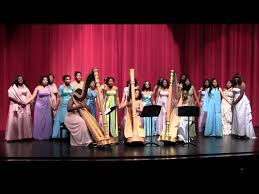
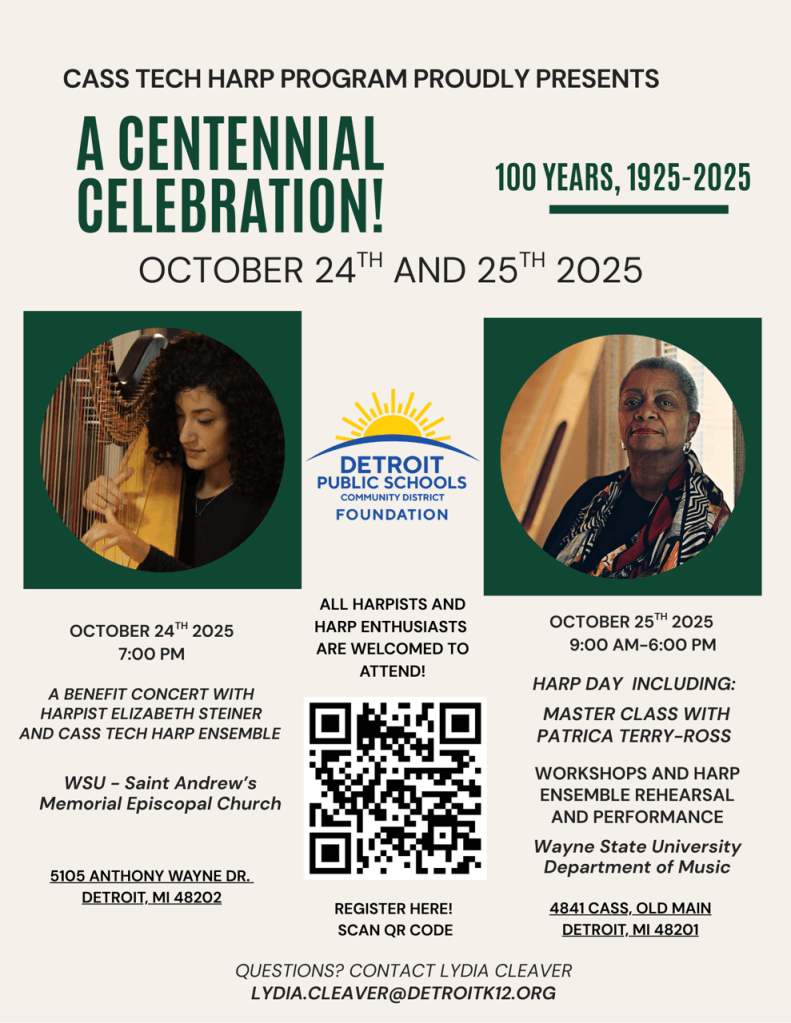
This month marks a remarkable milestone — the 100th Anniversary of the Cass Technical High School Harp and Vocal Program. In a time when we so often hear what’s wrong with public schools, especially within the Detroit Public Schools Community District (DPSCD), it’s important to pause and celebrate what’s right. Hidden within DPSCD is a shining jewel — the Cass Tech Harp and Vocal Program — led by the incomparable Ms. Lydia Cleaver.

Ms. Cleaver, a devoted educator and faithful member of my church, embodies what it means to serve with excellence and love. Day after day, she stands in the classroom as a steady force, doing the sacred work of teaching amid the chaos and challenges our community brings to her through its children. No matter their circumstances, Ms. Cleaver finds ways to lift, inspire, and prepare her students to rise beyond what many could ever imagine.

Think about it: teaching the harp — one of the world’s most delicate and expensive instruments — to Detroit’s young people, many of whom rely on public transportation just to get to school and benefit from free and reduced lunch programs. Yet when you encounter Ms. Cleaver’s students, you feel as if you’re standing in the presence of royalty. Their poise, grace, and confidence radiate urban sophistication and class.

Ms. Cleaver doesn’t seek recognition. She’s too busy molding the next generation of classical musicians. But her impact deserves to be acknowledged. Over the years, she has taken her students to Carnegie Hall in New York, to Europe, and to national and international competitions — all on what she calls a “McDonald’s hamburger budget.” Through sheer faith, creativity, and sacrifice, she has found ways to make the impossible possible.

It’s time we — the Cass Tech alumni community — rise to honor her and this program that has produced legends such as Dorothy Ashby and Alice Coltrane, and nurtured the same caliber of artistry that once surrounded Diana Ross. Ms. Cleaver herself is a proud Cass alumna and a graduate of the University of Michigan School of Music. She continues to campaign tirelessly to place harps in the hands of her students so they can practice and perfect their craft beyond school hours.

A hundred years of excellence is no small feat. It’s a living testimony that greatness still flows from the Detroit Public Schools Community District. Ms. Cleaver represents hundreds of dedicated teachers — past, present, and retired — who pour out their hearts and lives so our children can succeed, even in the most challenging circumstances.

To all Cass Tech alumni, and to all who love Detroit — this is our moment to say thank you. Let’s show our gratitude by showing up, giving back, and celebrating what is still beautiful and powerful about our schools.

🎶 Cass Tech Harp Program: A Centennial Celebration
100 Years: 1925 – 2025
📅 Thursday, October 24th, 7:00 PM
📍 Wayne State University’s Saint Andrew’s Memorial Episcopal Church
5105 Anthony Wayne Drive, Detroit, MI 48202

🎵 Master Class with Patricia Terry-Ross
📅 Friday, October 25th
📍 Old Main, Wayne State University
4841 Cass Avenue, Detroit, MI

Thank you, Ms. Lydia Cleaver, and thank you to every teacher who has ever sacrificed, inspired, and believed in our children. We may not say it enough, but today, from the bottom of our hearts — we are grateful.

Reclaiming Racial Reconcillation: Why the Wounded Must Lead the Healing

In the United States, the language of “racial reconciliation” is increasingly invoked in churches, corporate boardrooms, nonprofit organizations, and political platforms. Yet too often, the process is led and defined by the descendants of those who benefited most from racial injustice, rather than those who bore its deepest wounds. This imbalance not only distorts the process but also undermines its potential to be genuinely transformative.

True racial reconciliation cannot be orchestrated by those who have historically held the power, dictated the narratives, or controlled the systems of wealth and influence. It must be led by those most impacted by racial violence, dispossession, and systemic exclusion. Anything less risks becoming either a symbolic gesture or, worse, a retraumatizing reenactment of colonial power dynamics dressed in the language of healing.

When descendants of slaveholders, colonizers, or beneficiaries of racial hierarchies lead the reconciliation process, the outcomes often center on comfort and image management rather than truth, justice, or repair. Apologies are issued, but no reparations follow. Dialogues are held, but decision-making remains centralized in historically white institutions. Workshops are facilitated, but budgets remain unequally distributed. These patterns reinforce the status quo, pacifying discomfort without redistributing power.

This dynamic also privileges the emotional ease of the dominant group. The goal becomes creating a sense of closure, of “moving on,” rather than honestly confronting the enduring consequences of racial harm, including generational poverty, institutional mistrust, educational disparities, cultural erasure, and political disenfranchisement. In this sense, mainstream racial reconciliation efforts often cater to white guilt and fragility rather than Black trauma and resilience.

Having lived in the Black Christian evangelical world for the past 35-plus years, I have witnessed firsthand, across a wide range of Christian organizations, the bastardization of the concept of racial reconciliation. Sadly, even many Black Christians have internalized these diluted versions. As a result, the underserved — especially Black believers — have been marginalized within evangelical spaces, excluded from preaching opportunities, board leadership, and publishing platforms. Even when access is granted, it often benefits the individual rather than the broader community.

One of the critical missing links in all of this is the power of the Holy Spirit. As John 3:30 reminds us, “He must increase, and I must decrease.” The Spirit empowers us to think differently — to imagine reconciliation not as a symbolic gesture, but as a transformative, systemic process rooted in humility and divine justice.

There’s an expression that says, “Power concedes nothing.” Jesus understood that. In fact, He changed the game. He led with a radically inclusive vision — one that built a level playing field for all people, especially the poor and the oppressed. His Beatitudes are a blueprint for this reversal of worldly power: “Blessed are the meek, for they shall inherit the earth” (Matthew 5:5).

If biblical reconciliation is to reflect the heart of Christ, then power must be conceded, and systems must be redesigned and transformed. Acknowledgment and apology alone are not enough. What is needed is a rebalancing of power, voice, and resources. This shift must be systemic, not symbolic.

Here are five key principles I believe are essential for genuine reconciliation:

1. Leadership by the Wounded

Those most harmed — descendants of enslaved people, Indigenous communities, and historically marginalized groups — must lead the process. Their lived experience must shape the design, language, timeline, and goals of any reconciliation efforts. Healing must be led by those who know the pain.

2. Narrative Control

The stories and frameworks used to guide reconciliation must come from the grassroots. This includes centering oral histories, truth commissions rooted in community, and cultural practices that reflect the values of the oppressed, not sanitized retellings curated for institutional comfort.

3. Structural Reparations

There can be no true reconciliation without a material response. That means wealth redistribution, divestment from oppressive systems (such as the prison-industrial complex and exploitative corporations), and reinvestment in Black, Brown, and Indigenous futures.

4. Shared Governance

Institutional power must be shared — or surrendered. Boards, churches, universities, and civic bodies must include and empower those who were previously excluded, not as tokens but as equal—if not primary—stakeholders in decision-making.

5. The Right to Say “No”

True reconciliation honors the right of harmed communities to decline participation in performative or insufficient efforts. They must be able to reject gestures that do not lead to meaningful change and protect their own boundaries around trauma and healing. Without consent, any effort risks becoming a reenactment of control.

The future of racial reconciliation in America depends on a righteous disruption of the old frameworks. We must unlearn models that prize politeness over justice and comfort over truth. We must reject the temptation to “move on” before we’ve even faced the truth.

Churches, Christian organizations, universities, and governments must go beyond panels, pledges, and performative diversity campaigns. They must make room for radical honesty, historical reckoning, and the tangible restructuring of power. Without this, what is meant to heal will only deepen the wound.

This is not about revenge — it is about repair.
It is not about guilt — it is about justice.
It is not about erasing anyone’s humanity — it is about finally affirming the full humanity of those whose dignity has been denied for generations.

The path toward racial healing must be built by those who know the terrain of suffering and survival best. Their leadership is not only legitimate but also essential. Until we understand that reconciliation without justice is not true reconciliation, we will continue to mistake performance for progress.

Now is the time to shift the center
From the privileged to the oppressed.
From symbolic gestures to systemic change.
From control to shared liberation.

Only then can the body of Christ begin the work of true reconciliation — not as a moment, but as a movement. I’m just saying…. What say you?

Dear Detroit’s Candidates for Mayor: Don’t Forget the Children and Youth

Detroit is at a crossroads.

As the city prepares to elect its next mayor, much of the political conversation revolves around affordable housing, job creation, and economic development. Important? Absolutely. But if Detroit is genuinely going to rise—not just in buildings, but in spirit—it must begin with its children and youth.

This blog is a direct message to every candidate running for mayor in 2025:
We expect a bold, comprehensive youth development strategy to be a prominent part of your platform.

For far too long, young people in Detroit have been treated as the “future” when, in reality, they are the now. Too many urban policies are adult-centered, leaving children and teens to navigate broken schools, unsafe neighborhoods, and a digital world with little guidance and fewer opportunities.

Jobs Matter—But Our Youth Need More Than Employment. They Need Empowerment.

We acknowledge and appreciate the work of the former Youth Development Commission and the Skillman Foundation, whose early investments in youth employment were ultimately expanded under Mayor Duggan. That foundation matters.

But our young people need more than jobs—they need joy.

Empowerment means reducing childhood poverty and food insecurity, improving access to safe recreational spaces, investing in robust, year-round youth employment and entrepreneurship programs, and funding arts, sports, and cultural experiences in every neighborhood—not just downtown.

Reimagine Public Safety—Start With Public Healing

Perhaps it’s time to rename the Detroit Police Department to the Detroit Public Safety Department, with a central mission of protecting and healing our communities—starting with children and youth.

Let’s be honest: The word “police” is not neutral. For many Black children, it is traumatic—intertwined with a long history of systemic harm. As noted in The New Yorker, the roots of modern policing in the South trace back to slave patrols: organized forces designed to capture and control enslaved people. That legacy matters. It shapes how our youth see law enforcement today.

The new Public Safety Department must include:

  • Comprehensive trauma counseling
  • Violence intervention and prevention
  • Restorative justice programs
  • Community-based mentoring
  • Let’s stop saying just “public safety.” Say public healing.

Urban Youth Deserve Policy, Not Pity

Detroit’s children are not problems to manage—they’re people to invest in.

They deserve a mayor who will:

  • Build a Detroit Children’s and Youth Cabinet that includes actual young people and grassroots leaders
  • Establish a Citywide Youth Development Fund to support the real work being done in the neighborhoods

The next mayor must be bold enough to declare:

🗣 “We will not rebuild Detroit on the backs of abandoned youth.”

What We Need: A Real Urban Youth Strategy

Detroit doesn’t need more seasonal after-school programs or summer job fairs. We need a strategy—rooted in equity, creativity, and long-term investment. Here’s where to start:

1. Create a Department of Youth Wellbeing and Leadership

Not just a youth liaison or a few programs under Parks & Rec. We need a cabinet-level department solely focused on the mental health, education, safety, and leadership development of young people—especially in historically under-resourced neighborhoods.

2. Fund Neighborhood-Based Youth Hubs

Reimagine vacant buildings and underused city properties. Let’s turn them into youth centers equipped with mentorship programs, digital media labs, tutoring spaces, and safe recreation zones.
Think libraries-meet-startup-labs-meet-counseling-havens.

3. Prioritize Early Childhood Development

Affordable childcare and quality early education should not be luxuries. The next mayor must champion:

  • Early learning centers across every district
  • Trauma-informed training for everyone who works with children—from bus drivers to daycare providers

4. Invest in a Youth-Led Civic Agenda

Listen to our young people. Build a citywide Youth Council with real decision-making power—one that works alongside city departments and Detroit Public Schools to shape budgets, policies, and community design.

Nothing about them without them.

The city’s budget is a moral document. Show us where your heart is.

Detroit Can’t Wait.

If we don’t center kids in Detroit’s transformation, we will repeat the same cycles:
Development for the few. Displacement for the many. Disillusionment for the next generation.

Detroit’s children are not collateral damage—they are co-builders of our city’s future.

Let’s build a Detroit where kids don’t just survive—they thrive. Just some thoughts from who a brother who has devoted his life to Urban Youth Development, I’m Just Saying… What say you?