Who Killed Detroit’s Public Education System?

Well-meaning Adults!

Detroit’s public education system has faced profound challenges for decades. Those old enough to remember the 1968 Northern High School walkout—led by students Charles Colding, Michael Batchelor, and Judith Walker—recall a pivotal moment in the struggle for educational equity for Black students in the North End. For many, it was an early glimpse into the deep inequities that existed within the system.

Over the years, I have witnessed the gradual decline of public education in Detroit. In 1973, my dear friend, the late Judge Longworth Quinn, Jr., who served on the Detroit Board of Education, lamented, “We just need to blow the system up and start from scratch.” His words reflected not despair, but a desire to rebuild a system worthy of its children. Since that time, enrollment in Detroit’s public schools has fallen dramatically, due in part to the city’s population loss and in part to too many families losing confidence in the schools themselves. I often wonder how many families might have remained in Detroit had the educational system better met their needs.

Public education remains one of America’s noblest ideals. At its best, it opens doors to every child, regardless of race, income, faith, or background. It promotes civic engagement, inclusion, transparency, and accountability, while providing vital services to students with diverse needs. In many ways, it is democracy in action.

Yet somewhere along the way, we lost sight of our true north star: the well-being and flourishing of children. Countless reforms, often advanced by sincere and well-intentioned adults, have produced mixed results. New governance models, charter schools, vouchers, and state interventions have brought innovation in some cases and disappointment in others. Too often, children have borne the burden of experimentation.

Scripture reminds us that we are stewards of the next generation: “Train up a child in the way he should go” (Proverbs 22:6). The measure of any educational system, therefore, is not politics or ideology, but whether it nurtures the intellectual, moral, and social development of its students.

Detroit’s future calls for a comprehensive, community-driven vision for education—one that honors state standards while embracing transformative values rooted in service, accountability, and hope. Such a coalition must draw its authority not from political power, but from the trust of families and citizens who are willing to say, “We entrust you with our children.”

Perhaps the time has come to convene a citizens’ council dedicated to returning the focus of public education from systems and institutions to families, children, and youth. Its authority would rest not in elected office, but in the collective voice of the people, united by a single purpose: to help every child reach his or her fullest potential. In many ways, it would serve as a modern expression of the PTA or PTO. For this vision to succeed, however, the council must remain independent—accountable neither to foundations, government agencies, nor corporations, but solely to the families and communities it exists to serve.

Maybe this is an ambitious dream. Yet I remain convinced that public education can still embody the very best of democracy and become a beacon of opportunity for generations to come.

I’m just saying—what say you?
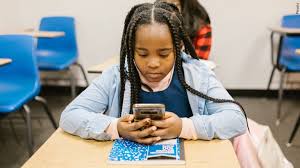
The Digital Divide Deepens: How Michigan’s New Phone Ban Hurts Black Students

Once again, government officials have dug a hole for Black children that will be nearly impossible to climb out of—and the fault lies with adults, not students.

To the legislators who supported Michigan House Bill 4141 and Senate Bill 495, and to Governor Gretchen Whitmer for signing them into law: be ashamed. Your decision to restrict the use of cell phones in K–12 public schools during instructional time has not helped our children—it has harmed them.

You may have created a barrier so deep that too many Black students will never recover.

A Divide That Already Exists

Before this law, our students were already behind. Michigan’s own data shows that more than 70% of Black school-age children lack reliable access to the internet or a computer at home. Without broadband access, without devices, without digital resources, Black students in Detroit and across the state are cut off from 21st-century learning. Now you have widened that gap even further.

This is the digital divide—not some abstract concept but a lived reality that shapes educational opportunity, economic mobility, and life outcomes for thousands of children.

You Have Deepened the Opportunity Gap

Let’s be clear: the issue with cell phones in the classroom isn’t inherently about discipline or distraction. It’s about access to tools and the lack of instruction on how to use them effectively. Banning technology that students already use, that they carry everywhere, is not a solution. It is a regression.

In true American fashion, when we don’t master something, we shun it. We demonize it. But our children live in a world defined by digital connectivity—whether educators like it or not. Until our pedagogical methods evolve, Black students will continue to be educated by a system rooted in the past.

Education Must Catch Up With the Times

Education in many classrooms today remains didactic—unchanged since ancient Greek academies. But students today are not passive learners; they are active, digitally connected, and they thrive in environments that are hands-on, interactive, and technology-enabled.

There are proven tools—Learning Management Systems like Google Classroom, Schoology, Canvas, and others—that integrate cell phones and digital devices into teaching. Teachers can use students’ phones as instructional tools for research, collaboration, and real-time learning. Yet rather than harnessing technology, we choose to restrict it.

The New Educational Underclass

By banning phones without addressing access and digital literacy, we are creating a new educational underclass—led not by malicious actors, but by well-intentioned adults who are afraid to embrace innovation.

But responsibility doesn’t stop with legislators.

Other culprits include:

  • Academic schools of education (colleges and universities) that train teachers in outdated methods.
  • A public education system driven by middle-class professionals disconnected from the realities of urban Black children.
  • Community influencers and parents who aren’t grounded in the neighborhoods they claim to serve.
  • And most troubling, a system that ignores the voice of the very people it is supposed to uplift: Black children in Detroit.

A Call to Action

Governor Whitmer. Michigan state legislators. Suburban educators.

We can be intimidated by change — or we can lead it.

Let’s reverse this curse.

While children in suburban districts walk into classrooms equipped with tablets, laptops, iPads, and an ecosystem of technological support, more than 70% of Black children in Detroit come with nothing to augment or fully participate in this technological era. That is not a discipline issue. That is an equity issue.

We have a powerful opportunity before us: to reformulate classroom experiences into environments that are engaging, interactive, and relevant to the way today’s students actually learn.

Two years ago, we implemented Learning Management Systems (LMS) into our core curriculum. The results have been nothing short of transformational. Each day begins with a dynamic, interactive module reviewing the previous day’s lesson. Students are not passive listeners — they are active participants.

While we have not conducted a formal academic study, I am confident enough to suggest that student retention is at or above 90–95%. Students are not only recalling content — they are internalizing it. They talk about it. They apply it. They retain it.

Can you imagine a classroom environment where over 90% retention becomes the norm rather than the exception?

Instead of banning tools, let’s study how to effectively integrate innovative technology into classroom settings. Let’s listen to our children. Let’s collaborate with educators on the front lines. Let’s empower teachers with the training, resources, and tools required for the digital era. And most importantly, let’s address device access and connectivity not as luxuries — but as educational equity issues.

The future is not waiting for us to get comfortable. The future is demanding, now is the time, and I’m just saying.

I’m Just Saying: It’s Time to Take Back Public Education

Somehow, the people who lead our governmental, philanthropic, and corporate sectors have decided that urban public education should be shaped and guided by corporate executives. Let me say this plainly: that decision is one of the greatest educational atrocities of our time. It may very well be the reason our children continue to be failed by the very systems meant to uplift them.

What troubles me even more is that we, as a society, don’t seem to recognize how deeply capitalism—unchecked, unchallenged, and unexamined—has damaged the world we live in. And before anyone starts labeling me a communist or socialist, let me be clear: I am a follower of Christ. Through a Christian lens, I view this conversation about education, human dignity, and communal responsibility.

Recently, I attended the screening of a new documentary produced by Mr. Quan Neloms. In it, a community activist said something that struck me with the force of a thunderbolt:
“Our students are not failing; our system is failing our students.”
That statement alone is worth a hundred billion dollars—especially since we’ve begun evaluating everything through the lens of dollars and cents.

For more than twenty years, I have watched our public educational institutions shift from being grounded in urban pedagogical wisdom to being transformed into corporate training centers. The focus is no longer on children, families, or community. Instead, the agenda is shaped by corporate profitability and workforce preparation. We have displaced parents from the center of their children’s educational journey and handed that authority to corporate and philanthropic executives—many of whom have never taught, never lived in our communities, and never raised a Black or Brown child.

And the justification seems to be rooted in a dangerous, unspoken theory:
that urban parents lack the love, care, or competence to know what is best for their own children.

What’s even more alarming is that far too many faith-based institutions have bought into the same narrative. Churches—historically the backbone of Black educational empowerment—are now echoing corporate talking points rather than community wisdom. Our system has shifted from prioritizing the public good to prioritizing profit. From nurturing critical thinkers to mass-producing compliant workers.

I often wonder what Horace Mann, the father of American public education, would think about the direction in which we’ve drifted. He fought for an education system that served everyone, but he was not confronted with the realities of race and diversity as we are today. Would he be shocked? Or would he say that the inequities we see are intentional design?

And that’s the question I wrestle with:
Are those in high places truly committed to giving Black and Brown children a quality education—one that would make them competitive with the privileged?

Back in 1973, my dear friend Judge Longworth Quinn Jr., who served on the Detroit Public Schools Board, said something I’ll never forget:
“The only hope for educational reform would be to blow it up and redesign it.”
More than 50 years later, he might very well have been an educational prophet.

We cannot allow our system to be reimagined by people whose primary interests are reform metrics, funding streams, and political agendas—not the dignity and destiny of our children. As my friend and retired educator William Batchelor often reminds me,
“We know how to educate our children.”
And my response today is: Let’s move the systems out of the way and let the educators do what they were called to do.

Beginning this February, Be-Moor Radio and the Be-Moor Radio Institute will launch an educational podcast series titled “Class Is in Session. This platform will feature students, educators, retired educators, parents, community leaders—and yes, we want you to be part of it. Our goal is to build a real, authentic grassroots movement that transforms education with tangible, measurable results.

We hope to uplift the legacy of champions like Helen Moore, Judge Longworth Quinn Jr., Fannie Jackson Coppin, Benjamin Banneker, Mary McLeod Bethune, and my aunt Katie E.M. Mallett—a proud Jackson State graduate who, as a young girl in Kosciusko, Mississippi, taught all her siblings before moving to Detroit and serving the Highland Park School System. These are the giants whose shoulders we stand on. And they are joined by thousands of unnamed educators who have carried the torch of Black educational excellence quietly and faithfully.

It is time—past time—to reclaim public education for our Black and Brown children. Time to rewrite our academic agenda based on our history, our values, our culture, and our vision.

So I ask you—
What say you?

Calling All Cass Technical High School Alumni: A Century of Excellence Worth Celebrating

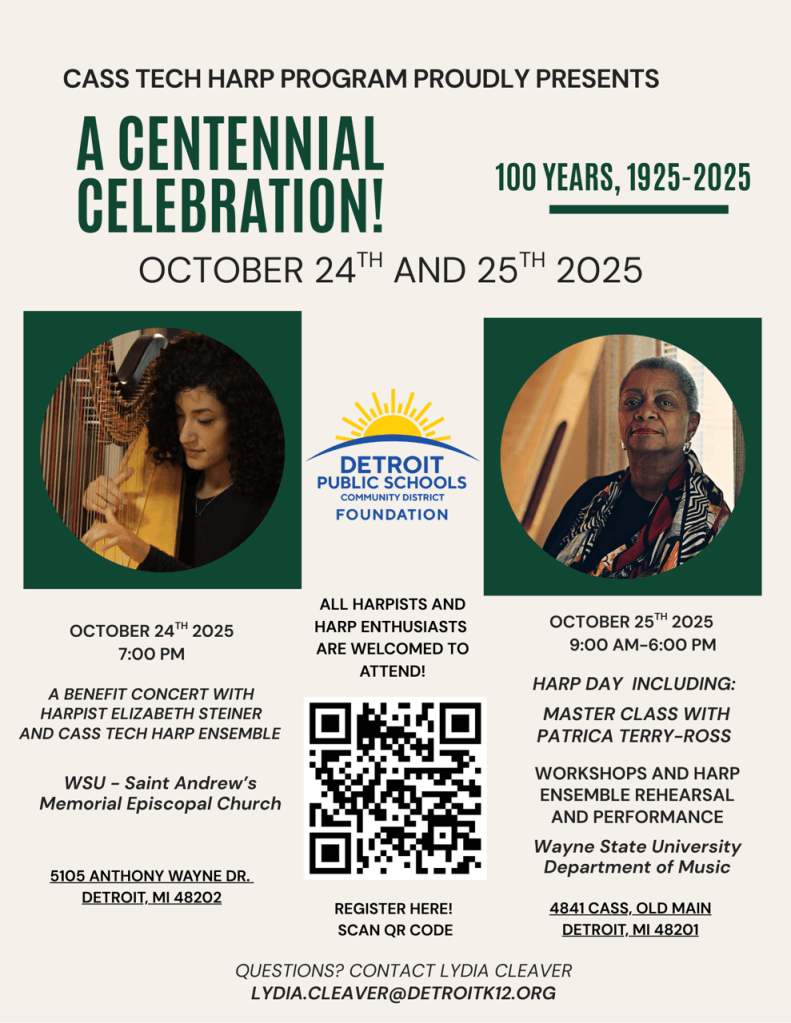
This month marks a remarkable milestone — the 100th Anniversary of the Cass Technical High School Harp and Vocal Program. In a time when we so often hear what’s wrong with public schools, especially within the Detroit Public Schools Community District (DPSCD), it’s important to pause and celebrate what’s right. Hidden within DPSCD is a shining jewel — the Cass Tech Harp and Vocal Program — led by the incomparable Ms. Lydia Cleaver.

Ms. Cleaver, a devoted educator and faithful member of my church, embodies what it means to serve with excellence and love. Day after day, she stands in the classroom as a steady force, doing the sacred work of teaching amid the chaos and challenges our community brings to her through its children. No matter their circumstances, Ms. Cleaver finds ways to lift, inspire, and prepare her students to rise beyond what many could ever imagine.

Think about it: teaching the harp — one of the world’s most delicate and expensive instruments — to Detroit’s young people, many of whom rely on public transportation just to get to school and benefit from free and reduced lunch programs. Yet when you encounter Ms. Cleaver’s students, you feel as if you’re standing in the presence of royalty. Their poise, grace, and confidence radiate urban sophistication and class.

Ms. Cleaver doesn’t seek recognition. She’s too busy molding the next generation of classical musicians. But her impact deserves to be acknowledged. Over the years, she has taken her students to Carnegie Hall in New York, to Europe, and to national and international competitions — all on what she calls a “McDonald’s hamburger budget.” Through sheer faith, creativity, and sacrifice, she has found ways to make the impossible possible.

It’s time we — the Cass Tech alumni community — rise to honor her and this program that has produced legends such as Dorothy Ashby and Alice Coltrane, and nurtured the same caliber of artistry that once surrounded Diana Ross. Ms. Cleaver herself is a proud Cass alumna and a graduate of the University of Michigan School of Music. She continues to campaign tirelessly to place harps in the hands of her students so they can practice and perfect their craft beyond school hours.

A hundred years of excellence is no small feat. It’s a living testimony that greatness still flows from the Detroit Public Schools Community District. Ms. Cleaver represents hundreds of dedicated teachers — past, present, and retired — who pour out their hearts and lives so our children can succeed, even in the most challenging circumstances.

To all Cass Tech alumni, and to all who love Detroit — this is our moment to say thank you. Let’s show our gratitude by showing up, giving back, and celebrating what is still beautiful and powerful about our schools.

🎶 Cass Tech Harp Program: A Centennial Celebration
100 Years: 1925 – 2025
📅 Thursday, October 24th, 7:00 PM
📍 Wayne State University’s Saint Andrew’s Memorial Episcopal Church
5105 Anthony Wayne Drive, Detroit, MI 48202

🎵 Master Class with Patricia Terry-Ross
📅 Friday, October 25th
📍 Old Main, Wayne State University
4841 Cass Avenue, Detroit, MI

Thank you, Ms. Lydia Cleaver, and thank you to every teacher who has ever sacrificed, inspired, and believed in our children. We may not say it enough, but today, from the bottom of our hearts — we are grateful.